Tuesday, 11 October 2011

Workshops at the schools of Hassan District

Sri Gurusiddamallarya High School, Kuraada halli, Arasikere Taluk.
Date: 05-07-2011
            Sri. Ganganna, Head Master along with their teaching staff welcomed us and introduced us to the students. Around 110 students from VIII and IX   were given to us for the day long workshop.
            We started off with introducing ourselves to the students and got their names and signatures, later on the pre-test was conducted through a simple questionnaire. The work shop began with a audio visual presentation by Mr. Mahesh on Grasslands and Blackbuck. The students were encouraged to ask questions and take in more information and clarify their doubts.

Students engrossed in the slide show.

 
            Later ‘WHO AM I’ was played in the class room itself, Students enjoyed the game. The booklet and the poster were distributed to the students and were asked to go through the content. They were given some exercises based on the booklet and poster.

Outdoor activities were:
o   Identifying  a grass from a plant, difference between a blade of grass and a leaf.
o   To collect different species of grass in their campus.

            The post-test questionnaire was given to the students. The sticker and labels were issued to students. Sri. Ganganna, Head Master and other teaching staff thanked us for the workshop; we thanked them as well for their kind co-operation.

Sri Sadguru Siddamallarya High School, Chaluvana Halli,  Arasikere Taluk.
Date : 05-07-2011

            This residential school is situated in a beautiful location, far from the village and main road. Mr. Jagdish the head master of the school arranged a formal inaugural function under a large Tamarind tree in the school field. To begin with he welcomed us and insisted the students to properly utilize this unique opportunity that has come to their doorstep.  Mr. Kumar gave a brief introduction about the workshop and the need for it. Soon after the pre test, we tied up the banner and revealed the picture of the black buck.  This exercise gave us a better insight into what the students knew about the subject. Mr. Manu elaborated the issue of black back and the reason we need to preserve them. He emphasized how grass perform the same function as the forests and provide us ecological services to Mankind.
            As Electricity was to be restored only for the after noon session the whole of the day was in the out doors. A lot of the confusions about the environmental issues were clarified orally. Soon after lunch the audiovisual presentations were made by Mr. Kumar. Later on the students were distributed with the education materials and activities based on them were carried out. They worked in groups and came out with oral presentations about various topics.

Shrikanth distributing the questionnaire.
       

      In a simple valedictory the staff thanked the workshop team and promised to carry out such activities suggested by the resource team.

Workshops at the schools of Tumkur District

Govt. PU College (High School Division), Puravara, Madhugiri Taluk.
Date: 04-07-2011
            Sri. Prakash, Head Master welcomed us, introduced us to the students and addressed the gathering. Around 120 Students from class VIII & IX participated in the daylong day workshop.
            We started off introducing ourselves to the students and got their names registered, later a pre-test questionnaire was issued to be answered individually.
The group of 100 students was split in to 2 batches. While the 1st batch had the slide show, the second was engaged in outdoor activities facilitated by Mr. Hemanth. Mr. Mahesh made the slide show and film show on Grasslands, Blackbuck and its co habitants.
The outdoor activities were; 
o   Difference between a grass and a plant, difference between a grass blade and leaf.
o   To collect different species of grass in their campus.
o   Playing the game WHO AM I.
o   To study the blackbuck material and poster and list out different birds, carnivores, herbivores and reptiles mentioned in the booklet.

            During the post lunch session 2nd batch was given slideshow and film show. The post-test questionnaire was given to the students. The sticker and labels were issued to students.


Kumar explaining about the poster.


            Sri. Prakash, Head Master and other teaching staff thanked us for the workshop; we thanked them as well for the co-operation.

Govt. High School, Ittige Dibbana Hally, Madhugiri Taluk
Date : 04-07-2011
            The workshop began with a simple introductory note by the head master Mr. Laxman singh. Mr. Manu had to restore to the chalk and talk method of teaching since there was no power supply in the whole of the morning session.  After an elaborate lesson on grassland and blackbuck he took a lot of questions from the students.
 

Manu answering the queries.
            In the post lunch session the students were divided into two groups and one group was attended slide the show by Mr. Kumar.  Mr. Manu distributed the materials for another group and made them to inspect the materials. After the session the groups were exchanged and the same process repeated. Then all the students were gathered on the stage of the open air theatre and made to sit in groups. Each of the group was assigned with some topics for group discussion. Using the material they were asked to prepare a short essay which they presented later on.
      At the valedictory function, a few students expressed their experience of the workshop in their own way. Every body felt happy to know more about blackbucks which they almost saw every other day and they did express that they enjoyed the day long workshop because of the friendly nature of the teachers.

Workshops at the schools of Mandya District

Govt. High School, Katteri, Pandavapura Taluk.
Date : 01-07-2011
            This day marked the beginning of the series of workshops to be carried out over five districts. The event was inaugurated by Mr. Kempugowda, member of Zillapanchayat, Mandya and long standing leader of Karnataka Rajya Raitha Sangha. In attendance were Mr. Thimmegowda, Head Master and his staff. Mr. Kempugowda appreciated the idea of sensitizing the rural children about local environmental issues and mentioned how both the central and state governments had identified lakhs of Acres of agricultural lands for establishment of Special Economic Zones and questioned how could farmers survive in the leftover land and share it with wildlife. Such policies are detrimental to wildlife as well as farmers, If we need to protect wildlife it is not just the farmers who have to sacrifice, the urban riches need to cut down their consumption he said.
            Soon after the registration and pre-test the students were taken through a slide show in which Mr. Kumar enumerated the story of blackbucks. After a small break the students were shown a film on grasslands. With intermediate stops he explained the issue in local language to make the show meaningful. Until lunch time questions by the students were duly answered. 

Kumar addressing the children about Blackbucks.


            In the post lunch session Mr. Manu involved the students in nature games. The resource materials were distributed and the students were grouped in dozens and encouraged to inspect the materials and have group discussions. Each group was assigned with a topic for which they found substance in the materials provided. A few students presented their learning during the valedictory function.

Govt High School, Jakkanahalli, Pandavapura tq, Mandya Dist.
  Date : 01-07-2011
            It was a small informal function in the school where Mr. Mohan Kumar, Science teacher invited and introduced us to the students. Around 100 Students were chosen for the daylong workshop who were pooled in from all three classes in the high school.  Sri. Kamalesh, Head master of the school addressed the gathering and said how lucky the students were to have such a workshop in their school.
            We started off with a pre-test questionnaire and the 100 students were split in to two batches. While the 1st batch had slide show the other batch was engaged in outdoor activities, Mr. P. Hemanth conducted the outdoor activities. Mr. Mahesh gave the slide show on Grasslands, Blackbuck and its co habitants. He gave every bit of information to the students and clarified their doubts after the show. 

Mahesh giving a slideshow on Blackbucks.

The outdoor activities were:
o  Playing ‘WHO AM I ?’ with names of particularly grassland species.
o  Learning to differentiate grass from a plant by observation.
o  To study the different species of grass in their campus through collection.
o  To study the blackbuck material and poster and list out different birds, carnivores, herbivores and reptiles mentioned in the booklet.
           
            In the post lunch session a film was shown alternately in two batches. Later a post-test questionnaire was given to the students. At the end of the day we thanked one another for the cooperation extended and before we parted blackbuck stickers and labels were distributed to students.


Students reading the Material.

Monday, 10 October 2011

Some Documentaries on grasslands and Black buck.

In our pursuit of putting together some useful documentaries about black bucks we scanned hundreds of them.  Our intention was to learn more about the species and of course to use them in schools to communicate with children. 


i.           Human planet part-6: Grasslands-the roots of power

        Production: BBC   English : 58 mins


Human Planet is a 8 part documentary series produced by the BBC and narrated by John Hurt. The 6th episode is a brilliant piece on Grassland and an eye opener about how Grasslands paved the destiny of Mankind and his survival that still clings on to them. It describes several rare stories never filmed before but will happen in the grassland ecosystem almost every day. The story of the tribal boys who are guided by the honey guide to a bee hive, the Kuruve hunters who track their prey for weeks to run them out to make the kill or the Cambodian fisherman who takes his five year old boy to pick snakes from the Marsh are all fascinating. But the nail biting the Sequence is that of the Derabo tribe of the African Grassland who drive out a pride of Lions to pinch some flesh off a large kill is spell binding. 


A lion in the midst of a wildebeest herd.


Domestic cattle being herded.


Grassland ecosystem, unlike the Tropical rain forest is not in its climax and the grazers have evolved to keep them a young ecosystem forever. Together the grazers and grasslands thrive. Like all animals of Grassland we humans mastered the art of harvesting grass. We not only control the grass but  its consumers and their predators for our own benefits.

ii.           Land of the tiger part-4 Desert Kingdom
       Production: BBC    English :48 mins

This is a 5 part documentary series produced by BBC. Narrator Valmik Thapar takes you through a journey across the tiger habitats in the Indian subcontinent. The fourth episode, Desert Kingdom deals with the wildlife of arid zones of the tiger country and very vividly visualizes the symbiotic life of blackbucks and demoiselle cranes with certain tribes of north western India. The documentary is a good choice for classroom viewing especially while talking of blackbucks and grassland habitats. In the rare footage you can see the Indian grassland in its perfect shape without much of the invasive species in them. The shots of the black buck are taken in Velavadar and the specimen are strong, black and bigger in built than the their south Indian cousins.
 

A blackbuck pair in Velavadar.


iii.       Point calimere-Little Kingdom by the Coast
Production: Shekher Dattatri              English : 30 mins

                This is a short documentary done by seasoned wildlife maker Shekar Dattatri for the Forest Department of Tamilnadu. It is a brilliant video showcasing of the vivid life forms of Point Calimere, the tiny sanctuary situated in southern tip of India. The blackbucks here share habitats with many rare creatures- the feral ponies, colourful crabs and migratory birds.  Being on the sea shore it attracts thousands of migratory birds and breeding turtles. Small patches of open scrub adjacent to the beach houses fairly good number of blackbucks.  There are some rare footages of the way blackbucks survive against the onslaught of domestic cows, competing feral horses and marauding dogs. In 2002 the swamps around Point Calimere were declared a Ramsar Site, a designation given to wetlands of international significance. Over a hundred species of migratory water birds visit these swamps in winter, but over the years their populations have been declining. Point Calimere. Little Kingdom by the Coast offers a glimpse into this remarkable ecosystem and the problems that confront it.

Wednesday, 28 September 2011

Field Testing the Education Material

It was the month of June and Environment was the catch word of the public. Hot debates and discussions about the environmental issues of our PLANET EARTH were on a high because of the World Environment Day celebrated on June 5th. This is the only time when people talk about Environmental status of the PLANET EARTH. Politicians and the press focus upon the Environment and feel sorry for the Health of the Planet. In order to show their concern a whole range of activities are undertaken by the government and the public. A lot of them are merely verbal and without anything materializing at the end. Various contests for the children like painting, elocution and quiz are the commonest.
Occasionally we come across people perceiving something different. Our friend Satish of Kadashettyhalli had a different plan altogether. Being an elected representative of the Kadaba Gramapanchayat in Gubbi Taluk of Tumkur District, he had initiated a Biodiversity Monitoring committee in his Panchyat, a feat carried out only by a couple of Gramapanchayath in the country. Manu and Hemanth were also involved in the process and had conducted a workshop for the Teachers. They had formed about twenty school biodiversity clubs with the limits of the Panchayath which were supposed to be serviced by the Mysore Amateur Naturalists on a bi- monthly basis. The Program was sponsored by the Biodiversity Board of the State and Satish was looking forward to rope in the Karnataka State Pollution control board (KSPCB) in the year's World Environment Day celebrations. With some discussions we hammered out a joint venture to make the week long celebrations colorful and spread out. 
 A week long Environmental Awareness Campaign was held for the entire cluster of Govt. schools in the Kadaba Grama Panchayat limits. Manu and Hemanth were part of the campaign and went there as resource persons for the campaign.  Manu suggested utilizing this golden opportunity to field test our material. We immediately agreed upon the suggestion since there was very little time left time for us to carry out the Black buck Education program.  Kumar & Mahesh who were the principal investigators joined the team the very next day.
For six days between the 5th and 11th June there was a festive mood in the schools. As we travelled from school to school conducting education programs, the Mobile unit of the KSPCB too came, anchoring itself in the school compound or any suitable place within the village. The huge white bus with colorful paintings all over attracted the entire village to the school premises. The village folk really were eager to see the elephant in the Bus! Someone had spread a rumor that the bus had an elephant calf that strayed into Mysore city recently. There were some onlookers who even thought it must be some beneficial scheme of the Government that intended to distribute some thing to the public free of cost. 


A PCB Staff explaining about alternate fuels.


The Extendable side walls were opened and the staff of the KSPCB had to stand beside to explain that there were no elephants on the bus nor were they in the village to distribute anything.  They had a tough time in explaining the themes show cased on the bus. There was the fuel issue, water issue and the Mining issues.


Kumar delebrating about the Black bucks.


Kumar and Mahesh made use of this unique opportunity to field test the material generated. They had the privilege of two batches of fifty students each with whom they spent a whole day.  The workshops were conducted in two batches at the Gramapanchayath office Auditorium at Kadaba. The slide show, booklet and suggested activities were all tested and they did show the expected results. However the interaction with the students enabled us to rectify some colloquial terms and the font sizes in the material which otherwise would have posed glitches. 


Hemanth conducting an awareness game.


Manu exchanging stories with kids.


Satish speaking to the children.

Getting dressed to meet the children

1. Teacher’s Manual
    As decided in the workshop at Tumkur, articles from various writers were collected. Some of them had to be translated into Kannada. The proposed manual was a ready reckoner for teachers who would be interacting with students after the workshop. It contained a lot of information about blackbuck- its morphology, demography and ecology in the most basic of languages. The target group was teachers from high schools. As there is no educational material readily available on blackbucks and Grasslands it is evident that they are not in a strong position to handle the issue. Neither did their school libraries have relevant books nor had they heard about the possibility of incorporating such issues into the curriculum. As a result we had to concentrate on simplifying the issues and make them usable in classroom teachings.
    Contribution from Mr. Prasanna suggested activities that are handy for both indoor and out door sessions. Some the activities like ‘Web of life’ and ‘Who am I? ’ could be directly linked to grassland issue. A few of the activities had very particular outcome but the local situations would not easily permit the activities in a day’s workshop. Yet the activities like the skit, biodiversity assessment ‘Fish in the pond’ were all incorporated into the manual as suggested activities.

2. Booklet for students
    In fact the greatest challenge in getting this booklet done was its simplicity in terms of words and design. We had to undergo a couple of rewritings simplifying the words in every round. Reducing the size of the text without curtailing information was our first emphasis. The illustrations of blackbucks by Mr. Vinayaka gave life to the booklet. Though the initial idea was to focus the booklet on blackbuck a lot of illustrations of its cohabitants got incorporated. Finally, fixing the right amount of text and relevant pictures on each of the pages became even more challenging and had to be carefully handled. 


Cover page of Student's booklet.


3. Poster for the students
    Students are known to be attached to a favorite picture in there formative years. May be a film star, a cricketer, ultra-modern automobile or in most cases a religious deity. In most of the cases children simply don’t have choices of a relevant picture of their own world. So we decided to come out with a colorful, almost realistic landscape design as a poster. Though the theme was blackbuck and its cohabitants the emphasis was upon grassland-upon which the local community thrived. While it was thought that the poster made a beautiful wall decorative in the study place of the student, it would also work as a reinforcing agent about its learning.


Poster-front.


Poster-back.


4. Sticker and labels
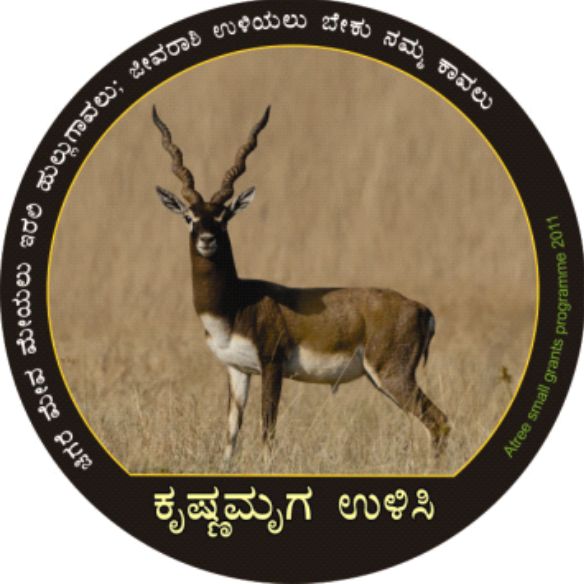
    A sticker was made with a simple photograph and a slogan that called to save the blackbuck. The book labels were kept at the very basic in its design concept. Very clear pictures of six grassland species in its up close mode were chosen. The pictures were placed on the left half of the label. Large space is given to the right where the student can write down the details. Names of particular animal were clearly mentioned below which would be very essential in making the animal popular among the students.


Labels.


Sticker.

Monday, 26 September 2011

Black Buck, Poachers and Innocents...

Tuesday, a busy day in my office. It was 2.30 in the afternoon. No lunch yet. There was a call from ACF Magadaiah to inform about a black Buck hunt in H.M.Kaval (Halu malledevara Kaval, 661 Acres) of Handanakera Hobli, Chikkanayakanahalli Taluk, Tumkur Dist, which is under his jurisdiction. He also informed us about the persons whom they have already taken into custody.  It was raining outside. I and Manohar started up quickly in my car. Manohar wanted to go in a 2 wheeler the reason being to reach the place inside the deep kaval area. And finally I was also afraid of the crowd in the village who came to protect the aarrested persons and decided to go by 2 wheeler. We started at 3, reached Doddaennegere gate which is about 40 kms of purely country road from Tiptur in just 35 minutes. We were welcomed by driver Nagaraj of forest department who was waiting for us at the gate. I was hungry. Had biscuits with a strong tea. We picked up Dr. Nagaraj, Veterinary doctor from Doddaennegere and continued our journey in forest dept. jeep to Kidakanahalli (Village) which is about 8 kms from there, where the persons have been held. We reached the village and we were shocked to see the crowd. 
I entered the house with RFO Nanjundappa , Forester Krishna Naik (both from Chikkanayakanahalli range) along with camera in my hand. I never saw such a scene before. I was shocked to see the head of a young Black Buck aged about 10 years separated from its body. The carcass of the animal was hanging from the top. The front legs were cut into half and lying dead. Eyes watered for a moment. Captured the scene. Then the carcass was taken to the kaval area for further process. Post mortem was done in the kaval area. We took the culprits to the place where he found the body. RFO Nanjundappa started questioning  Ramanaik on the spot. ACF, me and manohar started questioning  Ganganaika (Ramanaika’s father in law) a few yards away.  Finally we tallied both of their statements. Which was true. Post mortem was finished by that time and Dr. Nagaraj said it was shot by a country rifle at around 8pm on Monday night. We saw the shot on the right front part of the animal. 


Ramanaika & Ganganaika with the carcass.

The story goes on like this as said by Ramanaika and Ganganaika : One Ramanaika saw the carcass, around 8 am on Tuesday a portion of which had been eaten by foxes, lying beside road, where he has to travel to his place through the kaval area. He informed his father-in-law Ganganaika. The duo had taken the carcass to their house and were peeling the skin out to consume the meat. On a tip off watcher Girish and Umapati informed higher officials and raided the house and took them into custody.
From the post mortem report we came to conclusion that the poachers had shot the animal by a country-made rifle on Monday night at about 8pm but failed to take it to their possession, as the injured animal had run away into the forest in dark leaving behind the culprits. The animal died around 12 midnight.  And the persons who have taken into custody seem to be innocents as they have taken the carcass to consume it. 


Blackbuck head severed from it's body.


Bullet wound.

Consuming an endangered animal is also an offence and hence forest dept. officials took them and produced before the Magistrate along with the carcass. Dept. officials are eagerly waiting to arrest the real culprits who are hunting in that sector.
Thanks to Girish (watcher) who managed to get the information and informed higher officials about the matter. And thanks to ACF Magadaiah, Tiptur , who gave us the field experiences and manohar who joined me.


Entry wound seen on the skin.
Shrikanth and others at the scene.
Article contributed by Shrikanth Tiptur, Mythreya trust.